




Solana Casino Comparison for Australian Players
 Available in AU
The guide distinguishes holding and transferring SOL from using offshore casino services, then examines fees, withdrawals, bonuses and tax.

- The Legal Line for Australian Players
- How Solana Casino Access Works from Australia
- What a Solana Casino Comparison Can Actually Verify
- Withdrawals: Network Speed Is Only Half the Story
- Solana Slots and the Cost of Bonus Playthrough
- NFT Casinos: What the Available Evidence Does—and Doesn’t—Show
- Solana Casino Crypto and the Australian Tax Distinction
- Dice Play, Tiny Fees, and Transfer Risk
- Casino Games, Bonus Rules, and the Real Cash-Out Value
- SOL as a Casino Token: Deposits, Volatility, and Value
The Legal Line for Australian Players
The legal distinction is between owning SOL and using an offshore casino. Australians may buy, hold and transfer the cryptocurrency. That does not make an online casino lawful to provide in Australia. Under the Interactive Gambling Act 2001, overseas operators are prohibited from offering real-money online casino services to people in Australia, including casino games played with SOL.
The Act is directed at the operator rather than the individual punter. An Australian player is not directly penalised simply for using an offshore casino. That point is often reduced to “players are safe”. It means something narrower: the law’s prohibition on providing the service does not make the player its target. It does not turn the service into a lawful Australian product, or give a player a right to have a dispute resolved under local gambling protections.
That gap matters. A Solana casino may accept an Australian connection and display terms aimed at overseas customers, but accessibility is not approval. Nor does the use of cryptocurrency place the service outside the law. The relevant issue is the provision of online casino games to someone physically in Australia, not whether the stake is denominated in Australian dollars, SOL or another token.
Choosing a Solana casino in Australia calls for checking the details that are actually available, such as licensing, deposit minimums and payout information. Use these notes as a starting point and verify the terms that matter to you before playing.
License: Curacao Gaming Control Board OGL/2023/174/0082 (Dama N.V.) SpinsUp lists a Curacao Gaming Control Board licence, OGL/2023/174/0082, held by Dama N.V.
License: Curacao (operating since 2017) · Min. deposit: A$20 Uptown Pokies has operated since 2017 and lists a Curacao licence. Its stated minimum deposit is A$20.
License: Curacao eGaming (Dama N.V.) JeetCity Casino lists a Curacao eGaming licence held by Dama N.V.
License: Curacao · Min. deposit: A$20 (POLi) Lucky Dreams lists a Curacao licence and a minimum deposit of A$20 via POLi.
License: Curacao – Antillephone N.V. (Versus Odds B.V.) · Min. deposit: EUR 20 Thor Casino lists a Curacao licence through Antillephone N.V., with Versus Odds B.V. also named. Its minimum deposit is EUR 20.
License: Curacao Gaming Authority (Jumpman Gaming Ltd) DragonSlots Casino lists a Curacao Gaming Authority licence held by Jumpman Gaming Ltd.
Payout speed: crypto 30-120 minutes, fiat 24-72 hours · Min. deposit: A$30 MrPacho’s stated payout times are 30–120 minutes for crypto and 24–72 hours for fiat. Its minimum deposit is A$30.
License: Curacao eGaming OGL/2024/923/0383 (Antillephone N.V.) · Min. deposit: A$30 WinSpirit Casino lists a Curacao eGaming licence, OGL/2024/923/0383, through Antillephone N.V. Its minimum deposit is A$30.
License: Curacao Gaming Control Board JustCasino lists a Curacao Gaming Control Board licence.
License: Curacao Gaming Control Board OGL/2023/176/0095 (Hollycorn N.V.) Rollero Casino lists a Curacao Gaming Control Board licence, OGL/2023/176/0095, held by Hollycorn N.V.
I have seen the payment method treated as if it changes the legal character of the activity. It does not. The Interactive Gambling Act covers online casino-style services such as slots, poker and table games. Putting a blockchain transaction between the player and the operator does not convert the casino into an Australian-regulated service. The legal grey area is about the player’s exposure and lack of recourse, not a loophole that makes offshore provision permitted.
Enforcement sits with the Australian Communications and Media Authority. ACMA can act against unlicensed offshore gambling sites by blocking access, and it maintains a public register of gambling services prohibited in Australia. A specialist review has reported that the register contained more than 200 sites in 2026; that is a dated count, not a permanent measure of the market. A blocked address may interrupt access, but the underlying operator can remain offshore and outside the ordinary Australian complaint process.
The practical consequence is limited consumer protection. If an offshore casino freezes an account, refuses to release winnings or shuts down, Australian authorities do not provide the player with the protections and remedies available in a locally regulated gambling market. A company’s terms, customer support or claims about its standards are not substitutes for that recourse. From inside the industry, the distinction is plain: a dispute may be handled under the operator’s own rules, while an Australian player has little leverage if those rules are applied against them.


The absence of direct player penalties should not be read as legal safety. “No penalty for the punter” describes who the Act targets; it does not certify the casino, guarantee access, or promise recovery of funds. Likewise, a site continuing to load is not evidence that it has been authorised to serve Australians. Enforcement can be visible through blocking, while the loss in a private account dispute remains the player’s problem.
For anyone assessing a Solana casino comparison in Australia, the first line is therefore legal rather than technical: SOL itself can be lawfully held and transferred, but offshore operators are prohibited from supplying online casino games to Australian residents. The player is not directly penalised under that operator-focused rule, yet has no Australian legal protection if the offshore service withholds funds or disappears. Those are separate facts. Neither cancels the other.
How Solana Casino Access Works from Australia
The route from Australian dollars to a casino wallet is usually indirect. Most Solana casinos do not accept AUD by bank transfer or card, so the funding path runs through an Australian crypto exchange: AUD goes in, SOL is purchased, and SOL is transferred to the wallet address shown by the platform.
That describes the payment mechanics, not whether the service is lawful. Under the Interactive Gambling Act 2001, offshore operators are prohibited from providing online casino games to Australian residents. A site being reachable, accepting a wallet transfer or describing itself as a “Solana casino” does not make its service legally authorised in Australia. The Act targets operators rather than punishing individual players, but that does not make offshore play legally safe. If funds are withheld or an account is frozen, Australian players have no legal protection or ordinary recourse through Australian authorities.
Funding Path
Transfer Australian dollars to a crypto exchange such as Swyftx, CoinSpot, or Coinbase AU using PayID or bank transfer.
Use the available AUD balance on the exchange to buy Solana (SOL).
Send the purchased SOL from the exchange wallet to the specific deposit address provided by the casino platform.
From AUD to SOL
Swyftx, CoinSpot and Coinbase AU support AUD deposits through PayID or bank transfer. Once AUD is available on an exchange, the account holder can buy SOL and arrange a transfer to the casino’s deposit address. The exchange is the conversion point; it is not the casino itself, and a balance held there has not yet reached the gambling platform.
This separation matters because each service has its own account and payment controls. An exchange may require identity details or other checks before allowing deposits, trading or transfers. The casino may impose separate conditions before it credits an incoming payment. Completing a purchase on an exchange therefore does not guarantee that a casino account will accept the transfer or that the funds will appear as expected.
The deposit screen should be treated as an instruction for a specific asset and network, not as a general-purpose crypto address. The wallet sending the funds and the receiving platform need to support the same asset on the same network. A mismatch can leave a transfer unrecoverable. SOL transfers are irreversible: if funds are sent to the wrong address, they can be permanently lost. There is no card chargeback mechanism to reverse a blockchain transfer.
Check the receiving details before sending
Before moving funds, the practical checks are basic but consequential: confirm the displayed deposit asset, copy the address from the intended account, and compare the address in the sending wallet before approving the transaction. A small-looking typo is still a different address. The interface may make the transfer feel like a routine payment; on-chain, it is a one-way instruction.


The minimum deposit is not a universal figure. A specialist review reports minimums ranging from 0.01 to 0.1 SOL, with an AUD equivalent of about $2.80 to $28 at April 2026 prices. Those figures are a snapshot, not a promise about a particular platform or a lasting conversion rate. The deposit page is the relevant place to confirm the current minimum and any asset-specific conditions before buying SOL. Buying more than needed can leave funds exposed to price movement or parked in an account that cannot be used as expected.
A “quick” deposit also depends on what happens after the transfer is sent. The blockchain transaction and the platform’s decision to credit it are separate steps. The deposit instructions may specify a minimum, a supported network or other conditions; if those are not met, a transfer can arrive without being credited automatically. Keep the transaction record and do not assume that a visible balance on the exchange is the same as a casino balance.
A route with limited protection
Offshore casino accounts may also have their own terms for access. Using a VPN to get around location controls can lead to account seizure and loss of funds, so it should not be treated as a harmless connection setting. Larger withdrawals or bonus cash-outs may trigger KYC checks requiring ID verification, even when the initial deposit was accepted without the same review.
Legal Risk
Under the Interactive Gambling Act 2001, offshore operators are prohibited from providing online casino games to Australians, leaving players with no local legal protection or recourse if funds are withheld.
There is no Australian consumer-protection backstop for an offshore operator that closes an account or refuses to release funds. That risk exists before any deposit, not only after a dispute. Nor does a successful transfer settle the legal question: Australian law prohibits offshore operators from supplying online casino games to residents. The absence of a direct player penalty is not equivalent to approval or protection.
The practical sequence is therefore clear, but it is not risk-free: AUD is deposited with an exchange, converted to SOL, then sent to a specified platform wallet. Each hand-off involves a separate service and a separate point of failure. A displayed address can be copied incorrectly; a platform can apply its own account rules; and SOL’s value can change between purchase and any later conversion. Access is not assurance.
What a Solana Casino Comparison Can Actually Verify
A “best” label is a conclusion, not evidence. In a Solana casino comparison, the useful work is separating claims that can be checked from language designed to make an offshore operator look reassuring. I treat licensing, game-return information, provably fair tools and withdrawal KYC policies as separate questions. A strong answer in one area cannot stand in for evidence in another.
That distinction matters in Australia. The Interactive Gambling Act 2001 prohibits offshore operators from providing online casino games to people in Australia. A polished comparison does not change that position or make participation legally safe. If an offshore operator freezes an account or refuses to release winnings, Australian players do not have Australian legal protection against that outcome. The risk is not removed by a favourable review, a foreign licence claim or a technical feature.

Licensing: verify the claim, not the badge
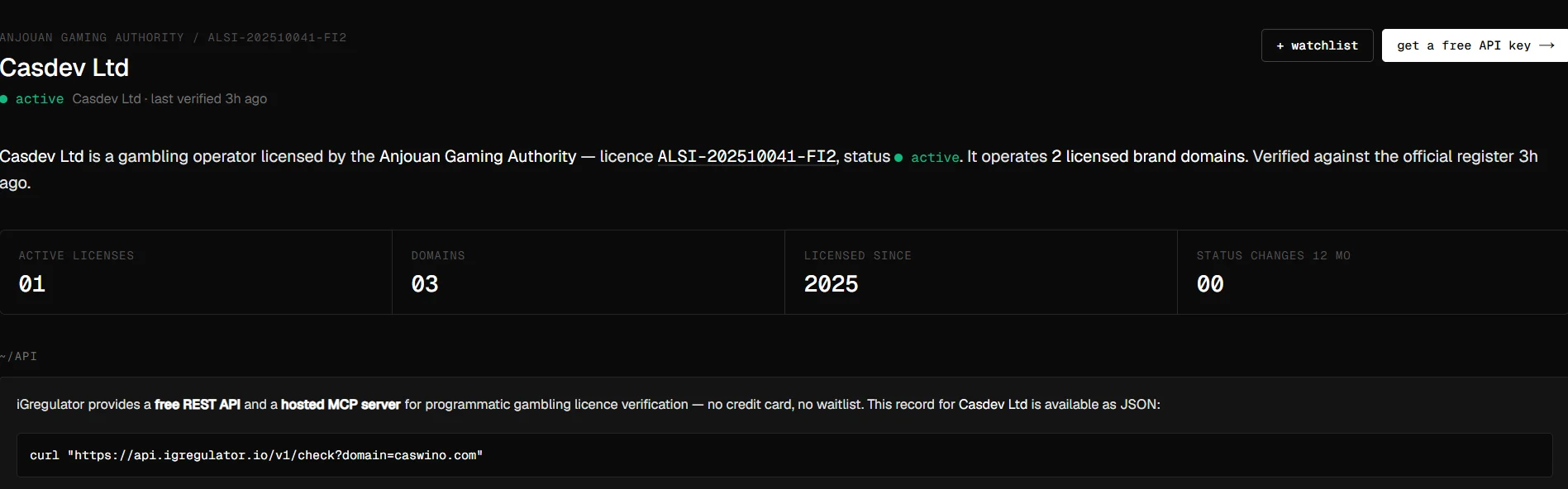
A licensing statement should identify the licensing authority and the entity named on the licence. A badge alone is not enough: it may lead to a genuine record, a general information page or nowhere at all. The operator’s legal name should also be consistent across its terms, payment rules and licence information. A mismatch is a reason to withhold confidence, not a detail to gloss over.
Even where a licence can be confirmed, its existence does not establish that the operator is authorised to offer casino games to people in Australia. Nor does it create Australian consumer protection. A comparison should make those limits explicit rather than treating an offshore licence as a local endorsement. “Licensed” describes a claim about the operator’s status in a particular jurisdiction. It does not mean “safe under Australian law.”
I would also look for the actual terms behind the claim, not a reviewer’s shorthand. If the comparison cannot identify what was checked, the licensing verdict is not independently useful.
RTP: a figure needs a defined scope
RTP, or return to player, is meaningful only when tied to the game and version being discussed. A general statement that a casino has “high RTP” says little if it does not identify which games the claim concerns and where the figure can be checked. A comparison should distinguish published game information from the casino’s own broad promotional description.
RTP Nature
Return to Player (RTP) is a measure describing a game’s performance over long-term play, not a forecast or guarantee of a result for an individual session.
RTP is not a promise about an individual session or a guarantee of a particular result. It is a measure used to describe a game over play, not a forecast of what one person will receive. A comparison that presents it as a way to predict a near-term outcome is overstating the evidence.
The same care applies when comparing figures across games. A single headline number cannot establish that an entire casino has better value, and it should not be presented as though it settles the question of whether an operator is suitable. Specificity matters. So does restraint.
Provably fair: inspect what the tool lets players check
“Provably fair” sounds conclusive, but the label itself proves nothing. The relevant question is whether the operator explains a process that allows a game result to be checked, and whether the explanation is clear enough to follow. A comparison should state what is verifiable and what remains an assertion by the platform.
A technical explanation, a verification function and a result that can be independently checked are different things. If a comparison reports only that a site “uses provably fair technology” without describing the check available to players, it has repeated a marketing claim rather than assessed it. I would not treat a feature as verified merely because it appears on a promotional page.
Nor does a fair-result check answer every question about the operator. It does not verify licensing, settle an account dispute or establish that withdrawal terms will be applied fairly. One check, one limited purpose.


Withdrawal KYC: read the rule before relying on it
A comparison should record what the operator says about KYC checks at withdrawal: when identification may be requested, what documents may be required and whether bonus-related cashouts have additional conditions. These details belong in the assessment because an account can face checks when money is due to be released. Larger withdrawals or bonus cashouts may trigger requests for identity documents.
The key evidence is the operator’s written policy and any stated conditions, not a reviewer’s impression that withdrawals are “easy.” A comparison should avoid promising that an account will pass checks or that a particular payout will be approved. It should also distinguish a published policy from an outcome that cannot be guaranteed in advance.
What a comparison can responsibly conclude
The phrase “best Solana casino” can suggest a definitive ranking, but the evidence supports only narrower conclusions: a stated licence was checked, a game-return claim has a source, a fairness feature has an explained verification process, or a KYC policy is available to inspect. Those are useful findings. They are not a seal of approval.
I keep the boundary visible. Evidence can clarify what an offshore platform claims and what a player can verify before engaging with it. It cannot supply Australian legal protection if the operator later withholds funds or closes the account. A comparison is a record of checks, not recourse.
- A verified license does not equal Australian legal authorization.
- RTP figures must be tied to specific game versions to be meaningful.
- Provably fair tools are only useful if the verification process is transparent.
- KYC policies should be inspected before depositing to understand withdrawal hurdles.
Withdrawals: Network Speed Is Only Half the Story
Solana can confirm a transaction in about 400 milliseconds, with the balance updating immediately, according to a specialist review. That describes the network—not the casino’s decision to release funds. A withdrawal may sit in an operator’s queue before any transfer is sent. A specialist review puts native SOL withdrawals at 30–60 seconds on competent platforms, but that estimate does not cover an internal hold or manual check.
The distinction matters when a cash-out is pending. Casino processing can take longer than the blockchain transfer, and a request may be delayed for review. Larger withdrawals and bonus cash-outs may trigger KYC checks requiring ID verification. The published cash-out terms should be read before depositing; a fast network cannot override a casino’s conditions.
Fees also have two layers. Solana’s network fee is separate from any charge imposed by the operator. A specialist review reports casino withdrawal fees of 0.1% to 1% of the amount, so the amount received may be lower than the balance requested.
A VPN can create a more serious problem: an operator may treat its use as a breach of its terms, seize the account and withhold funds. That risk is separate from network performance. No speed estimate makes a disputed account recoverable.
SOL transfers are irreversible. If an address is entered incorrectly, the funds can be permanently lost; there is no routine reversal process to rely on. I treat the address check and the operator’s payout status as separate controls: one prevents a transfer error, the other reveals whether the casino has actually released the funds.
Fast chain. Casino queue.

Solana Slots and the Cost of Bonus Playthrough
A slot’s contribution rate determines how much of a qualifying stake counts towards a bonus wagering requirement. Slots typically contribute 100%, so the full stake is counted. Blackjack and roulette may contribute only 10–20%. That difference can make slots appear to be the straightforward route through playthrough terms, but it does not make a bonus easy to clear or valuable.
The wording matters. A casino may advertise a bonus as “easy to clear” because slots count fully, while leaving the size of the wagering requirement, eligible games, time limit and cash-out cap to do the real work. The contribution rate answers only one question: how much of a bet is credited towards the requirement. It says nothing about how much may be lost during play or what happens to winnings once the requirement is met.
Bonus funds are not the same as withdrawable cash. Winnings generated from them must be wagered with real money before withdrawal. The terms may also specify which slot games qualify, whether a particular game contributes less, and whether play on excluded games can void the offer. A headline contribution rate is therefore not enough; the game-specific rules and cash-out conditions need to be read together.
This is where the apparent simplicity of a slot bonus can mislead. A full contribution can make each qualifying stake count in full, but the total amount of play still depends on the requirement attached to the bonus. A large requirement can mean substantial turnover before cash-out is available. During that play, the balance can fall. The promotional value is conditional, not a sum already earned.
- Check the total wagering requirement
- Verify eligible slot games
- Review maximum cash-out caps
- Rely solely on contribution rates
- Assume bonus funds are immediate cash
- Ignore time limits on offers
I have seen the contribution figure given the most prominent position because it is easy to compare. The less visible terms decide whether it matters. Check whether the requirement applies to the bonus alone or includes the deposit, which games count, and whether there is a maximum amount that can be withdrawn from bonus play. Read those cash-out terms before depositing, not after a winning balance appears.
A Solana slot machine is still a slot game; using SOL does not change how its contribution is calculated. Nor does a fast blockchain transfer alter the casino’s bonus rules. Keeping those mechanisms separate prevents a payment feature from being mistaken for a better offer.
There is also a legal boundary that promotional language cannot soften: under the Interactive Gambling Act 2001, offshore operators are prohibited from providing online casino games to people in Australia. Using one is not legally safe simply because the player is not directly penalised. Offshore operators offer limited consumer protection, with no recourse through Australian authorities if funds are withheld or a platform closes. A VPN can also lead to account seizure and loss of funds.
The arithmetic is only part of the decision. Terms decide the rest.
NFT Casinos: What the Available Evidence Does—and Doesn’t—Show
The word “NFT” can make a casino offer sound like a different kind of product. It may refer to a digital collectible, a token used to represent membership, or simply a theme in the platform’s branding. Those meanings are not interchangeable. An NFT existing on Solana does not, by itself, establish that it can be used to place bets, claim a reward or withdraw funds.
I have learned to separate the label from the mechanics. The useful questions are practical: what does the token actually permit, who issues it, and what happens if the account is closed or the operator changes its terms? Without clear, enforceable answers, an NFT should not be treated as a casino balance or as proof of access to a particular benefit. Ownership is not the same as a right to cash out.
The payment detail is more concrete. A specialist review reports that some Solana casino platforms accept USDC on the Solana network for deposits and play, alongside SOL. That describes a payment option, not an NFT feature. USDC is a cryptocurrency token; its presence does not mean that a casino’s NFTs have financial or gameplay utility. The distinction matters because promotional pages can place tokens, collectibles and payment methods under one broad crypto heading, even though they serve different roles.
A platform’s own description should therefore be read as a claim about its terms, not as independent confirmation of lasting value. If an NFT is said to unlock something, the relevant detail is the written condition: whether the benefit depends on holding the token, whether it can be withdrawn or transferred, and whether the operator reserves the right to change the offer. Vague language such as “exclusive access” explains little until the access and its limits are specified.
NFT Limits
Ownership of an NFT does not automatically guarantee a right to cash out or provide legal protection under Australian gambling laws.
There is also a separate Australian boundary. Under the Interactive Gambling Act 2001, offshore operators are prohibited from providing real-money online casino games to Australian residents. A blockchain token does not alter that position, and using an offshore site is not legally safe merely because the transaction is made with crypto. Australian players have no legal protection if an offshore operator freezes an account or withholds funds, and no recourse through Australian authorities if the platform closes.
That makes the NFT label a poor shortcut for judging a casino. It does not establish that a platform is legitimate, that a token has resale value, or that a promised benefit will remain available. Nor does a Solana-based payment option answer those questions. The payment rail is one thing; the operator’s obligations and the token’s actual terms are another.
I would treat NFT language as a description to verify, not a benefit to price into a decision. If the platform cannot explain in plain terms what the token does and what rights come with it, the advertised distinction may be mostly packaging. No special access follows automatically.
Solana Casino Crypto and the Australian Tax Distinction
Australian tax treatment draws a line between recreational gambling winnings and the crypto used to gamble. Recreational gambling returns are generally not taxable as income. That does not mean a win made with SOL is automatically outside the tax system: cryptocurrency is treated as an asset for capital gains tax purposes, and profits from gambling with SOL can attract CGT.

That distinction is easy to miss in a crypto casino account, where the balance is shown as tokens rather than Australian dollars. The gambling result and the asset’s tax treatment are separate questions. A recreational win may not be taxable as gambling income, while a gain connected with SOL used in gambling may still have capital gains consequences. The label “tax-free winnings” can hide that second issue. Different calculation.
I have seen players focus on whether they won or lost overall and assume that answers the tax question. It does not. The relevant distinction is between the general treatment of recreational gambling winnings and the ATO’s treatment of cryptocurrency as an asset. A losing session does not automatically cancel out a capital gain, and an account balance alone does not explain the tax outcome.
Losses have a narrow role. A specialist tax review describes gambling losses as available to offset gains only when the person qualifies as a professional gambler; that classification is difficult to establish. Recreational players should not assume that losses from one session, or across a period of play, can be deducted from gains. The high threshold matters because treating regular gambling as professional activity is not a simple choice made for tax convenience.
This is a reason to keep clear records of SOL movements and gambling activity, rather than relying only on the casino’s displayed balance. The value involved is not necessarily captured by the outcome of a bet alone. Where the tax position is material or unclear, advice from an Australian tax professional is more reliable than a casino’s promotional explanation.
The practical takeaway is limited but important: recreational gambling winnings are generally not taxed, yet SOL’s status as an asset means gambling with it can raise a separate CGT issue. A crypto casino does not remove that distinction.
Tax Distinction
While recreational gambling winnings are generally not taxable, the use of SOL may trigger Capital Gains Tax (CGT) as cryptocurrency is treated as an asset by the ATO.
Dice Play, Tiny Fees, and Transfer Risk
Dice-style games make the appeal of Solana’s low transaction cost easy to see. A casino interface can display repeated small wagers, while the blockchain is involved in moving funds to or from the platform rather than recording each game outcome as a separate transfer. That distinction matters: low network fees do not make the wagers themselves cheap, nor do they say anything about the game’s odds or the operator’s terms.
Solana’s average transaction fee is $0.00025 USD per transaction—near-zero in practical terms. The saving is most relevant when funds need to move between a wallet and a platform. It is not a discount on losses, a guarantee of fair play, or protection against an account restriction. I have seen fee language used as shorthand for “low cost” when it describes only one small part of the transaction.
There is a harder limit. A confirmed SOL transfer cannot be reversed by asking the sender’s exchange or wallet provider to retrieve it. If funds go to the wrong address, they are permanently lost. The small fee can make a transfer feel trivial; the amount sent is not trivial if the destination is wrong. Checking the address and the asset network before sending is basic operational discipline, not a formality.
The legal context also remains unchanged by the payment method. Under the Interactive Gambling Act 2001, offshore operators are prohibited from providing online casino games to Australian residents. Using SOL does not make an offshore casino legally safe, and Australian authorities do not provide a recovery route if an operator withholds funds or closes. A low-fee transaction does not reduce that exposure.

VPN use adds a separate account risk. An operator may treat a VPN as a breach of its terms and seize an account or funds; the transfer’s speed and fee offer no remedy. This is why I separate network mechanics from platform promises. “Instant” describes neither the fairness of a dice game nor the ability to recover money after a dispute.
For Australian readers, dice-style play is therefore best understood as a demonstration of Solana’s inexpensive transfers, not as an endorsement of casino use. The network can move value cheaply. It cannot make a prohibited service lawful, reverse a mistaken payment, or compel an offshore operator to return funds. Low fee. Irreversible transfer.
Casino Games, Bonus Rules, and the Real Cash-Out Value
A bonus is not cash available for withdrawal. Winnings credited from bonus funds have to be wagered with real money before a cash-out is permitted. The practical value of an offer therefore depends not just on its advertised amount, but on the conditions attached to it: the wagering requirement, which games count, any time limit and any cap on winnings.
The wording matters. A requirement may apply to the bonus alone or be calculated against a broader amount; those terms produce different play obligations. Game eligibility can also change the calculation. A wager placed on a game that contributes only partly toward the requirement makes less progress than the stake might suggest. An offer can look generous while its rules make the route to withdrawable funds long or uncertain.
Bonus Playthrough
Example: 5 SOL bonus × 40x requirement = 200 SOL in total bets required before withdrawal.
A specialist review gives one illustration: a 5 SOL bonus with a 40x requirement calls for 200 SOL in bets before withdrawal. That is an example, not a standard term across casinos. The number describes turnover, not money that must be lost, but every wager still carries the game’s risk. Turnover is not value.
Free spins need their own check. A specialist review describes free-spin winnings being credited as bonus funds and subject to a separate wagering condition, such as 50x. That is not a universal rule; the casino’s terms determine whether winnings are withdrawable, restricted to particular games, or tied to additional play. “Free” describes the spins, not necessarily the cash-out.
I assess a bonus by following the full path from credit to withdrawal: what counts toward playthrough, which games qualify, how long the offer lasts, and whether a maximum cash-out limits the result. The headline amount is only the opening figure. Read the cash-out terms before depositing, not after a win.

There is also a legal boundary that bonus language does not change. Under the Interactive Gambling Act 2001, offshore operators are prohibited from providing online casino games to Australian residents. Using an offshore casino is not legally safe simply because a player has not been prosecuted; Australian authorities offer no recourse if an offshore operator withholds funds or closes. Larger bonus cash-outs may trigger KYC checks requiring ID, and VPN use may lead to account seizure and loss of funds. SOL transfers are irreversible: a payment sent to the wrong address is permanently lost.
“Matched” is not “withdrawable.”
SOL as a Casino Token: Deposits, Volatility, and Value
SOL is a funding asset, not a fixed-value casino credit. A balance shown in SOL can remain unchanged while its value in Australian dollars moves. That distinction matters at both ends of play: the AUD cost of the SOL sent to a casino may differ from the AUD value of the SOL later received.

The casino balance is only one part of the calculation. If SOL falls in value between deposit and withdrawal, winnings can buy less in AUD even when the number of SOL has increased. A rise can work the other way, but it is not a return the casino has promised. The token’s market price supplies the uncertainty. “Crypto-friendly” describes a payment route, not protection from that movement.
Conversion adds another layer. Services used to exchange AUD for SOL, or SOL back into AUD, apply KYC and anti-money-laundering requirements. A casino may also request identity documents before releasing a larger cash-out or bonus-related balance. Those checks are separate from Solana network activity: a completed transfer does not mean an exchange or operator has finished its own review.
The cleanest comparison is therefore not simply the amount of SOL deposited against the amount withdrawn. The relevant value is the AUD equivalent at each conversion, alongside any applicable service or operator charges and the stated cash-out conditions. Those terms belong in the decision before funds are sent, not after a balance has been won. No fixed AUD outcome.
I have seen token-denominated balances make a transaction look settled while the underlying fiat value keeps moving. That is not a flaw in the casino ledger; it is the exposure created by holding a volatile asset. A “bonus” or displayed balance does not cancel it.
SOL transfers are irreversible. Sending funds to the wrong address can mean permanent loss, and a VPN may lead to account seizure and loss of funds. Offshore casinos are prohibited from offering online casino games to Australian residents under the Interactive Gambling Act 2001; using one is not legally safe merely because a player has not been prosecuted. Australian authorities offer no recourse if an offshore operator withholds funds or closes. These risks sit beside the price risk, not beneath it.
How do Solana casino deposits and withdrawals work?
Deposits usually involve buying SOL with AUD on an Australian exchange and transferring it to the casino’s deposit address on the correct network. Withdrawals depend on the casino’s processing: automated ones may take 5–15 minutes, while manual processing can take up to 72 hours; the Solana network itself is typically much faster.
What fees, limits, and speeds apply to SOL casino deposits?
Minimum deposits typically range from 0.01 to 0.1 SOL, or about AUD$2.80–$28 at April 2026 prices. The average Solana transaction fee is about US$0.00025, while some casinos charge withdrawal fees of 0.1%–1%; a fast withdrawal should take under 10 minutes on the network, though casino processing can take longer.
How do I make a SOL casino deposit?
Deposit AUD to an Australian exchange, buy SOL, then transfer it to the casino’s deposit address. Check that the asset and network match the casino’s instructions, since sending SOL to the wrong address can make the transfer unrecoverable.
What is the minimum deposit for a Solana casino?
Minimum SOL deposits typically range from 0.01 to 0.1 SOL, approximately AUD$2.80–$28 at April 2026 prices.
Can I deposit other cryptocurrencies at a Solana casino?
Some Solana casinos also accept USDC on the Solana network, so deposits are not always limited to SOL.
Is it legal for Australians to gamble with Solana?
Australians can legally buy, hold and transfer SOL, but offshore operators are prohibited from providing online casino services to people in Australia under the Interactive Gambling Act 2001. The Act targets operators rather than individual players, who are not directly penalised under that rule, but offshore play is not thereby authorised or protected.
Are Australian Crypto Casinos Safe?
Offshore crypto casinos do not provide Australian legal protections if they freeze an account or withhold winnings. A site being accessible or accepting SOL does not mean it is authorised to serve Australians.
Written by the editors at Caswino Casino.