
Caswino Player Reviews Australia: What Recent Feedback Shows
 Available in US
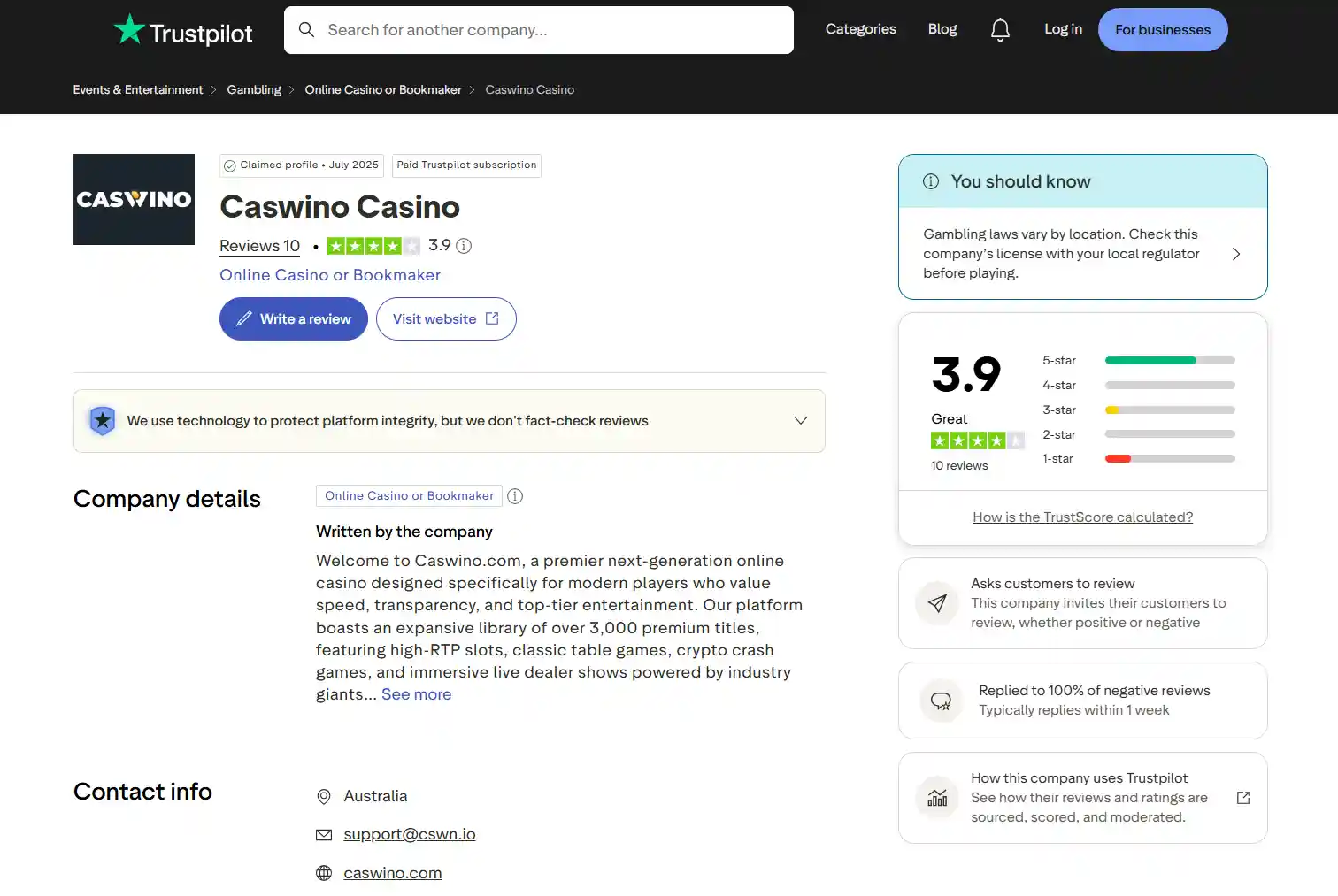
Recent Caswino reviews are positive overall, but the public sample is still small enough that individual experiences should not be treated as proof of how every account will perform. As of 8 September 2026, Caswino’s Trustpilot profile shows a TrustScore of 3.8 out of 5 from nine reviews. The visible feedback includes praise for the interface, customer support and some successful withdrawals, alongside complaints about account access and promotional-code problems. A separate complaint trail on Casino Guru also shows that KYC and withdrawal disputes can become more complicated than a simple star rating suggests.
The useful way to read this feedback is by theme. Reviews can show where players repeatedly notice friction or convenience, but they cannot establish Caswino’s licence status, Australian legal position, game fairness or a guaranteed payout time. Those questions belong to the site’s Caswino licence and trust analysis, the Australian legal context and the dedicated Caswino withdrawals guide.
- The current review picture is useful but still small
- Usability is the clearest recurring positive theme
- Support receives both praise and criticism
- Withdrawal reviews need more context than a star rating
- KYC complaints are about process, not proof of wrongdoing
- Bonus complaints often turn on communication and eligibility
- What the Australian reviews add to the picture
- Casino Guru adds complaint detail, but its signals also need context
- How to read a casino review without overvaluing it
- Signals worth watching as more Caswino feedback appears
The current review picture is useful but still small
Nine Trustpilot reviews are enough to identify recurring subjects, but not enough to make a broad statistical claim about the experience of Caswino’s entire customer base. On the current profile, 67% of ratings are five-star, 11% are three-star and 22% are one-star. That distribution explains why the overall score is positive while still containing sharply negative experiences.
The profile also matters because it shows how the reviews were submitted. Trustpilot labels most of the visible reviews as “Unprompted”, while one December 2025 withdrawal review is marked “Verified”. The company profile states that Caswino invites customers to review, whether their experience is positive or negative, and Trustpilot says the company has replied to all negative reviews shown in its summary. Those labels add context, but they do not turn a review into an independently audited account of what happened.
Freshness matters as well. The newest visible reviews are from August 2026, while some of the negative and mixed feedback dates from earlier in the year. A small profile can move noticeably when only one or two new reviews are added, so the 3.8 score is best understood as a current snapshot rather than a permanent reputation grade.
Usability is the clearest recurring positive theme
Several recent reviewers focus on the site’s layout rather than bonuses or winnings. An August 2026 Australian reviewer praised the straightforward menus and the ability to reach games without searching through complicated navigation. Another Australian review from July described the interface as clean and easy to use, with pages loading quickly.
This theme is more useful than it may first appear because interface comments are relatively narrow claims. A player can reasonably report that they found navigation simple or mobile pages responsive without implying anything about licensing, withdrawal policy or game outcomes. When several recent reviews independently mention similar usability points, the pattern is worth noting even though it remains subjective.
The same caution applies in the other direction. A smooth interface does not reduce the importance of checking banking conditions, account verification or regulatory context. Readers comparing the overall product can use the full Caswino review for the broader feature picture, while reputation comments are most useful as one layer of that assessment.
Support receives both praise and criticism
Customer support is another repeated topic. Positive reviews name support staff and describe fast or helpful interactions. Caswino also provides live chat and lists the support email address [email protected], so there are direct channels available when an account issue needs attention.
At the same time, one Australian one-star review described difficulty reaching support after an account-access problem. Caswino’s public reply supplied an alternative contact address and suggested that the login issue might have involved the registered email address. That exchange shows why a complaint and the operator’s response should be read together. The review records the customer’s frustration; the reply records the operator’s explanation. Neither side alone proves what caused the problem.
A practical lesson is to keep transaction confirmations, support emails and relevant account messages when a problem develops. That creates a clearer record if the issue later needs to be escalated. It is more useful than assuming that a positive review guarantees quick help or that one failed contact attempt means support is universally unavailable.
Withdrawal reviews need more context than a star rating
Caswino’s public reviews include both successful withdrawal reports and more difficult cases. One Trustpilot reviewer from Australia described a successful first withdrawal, while another praised fast withdrawals alongside support. These are useful examples of completed player experiences, but they do not establish a fixed processing time for everyone.
The opposite pattern also appears elsewhere. A Casino Guru complaint from a Norwegian player described repeated withdrawal attempts alongside an extended verification process. The case was ultimately closed because the player stopped responding while a video-verification step remained unresolved. That outcome is important: the complaint shows that verification can become a practical obstacle, but it does not establish that every Caswino withdrawal will be delayed or that the same sequence applies to Australian users.
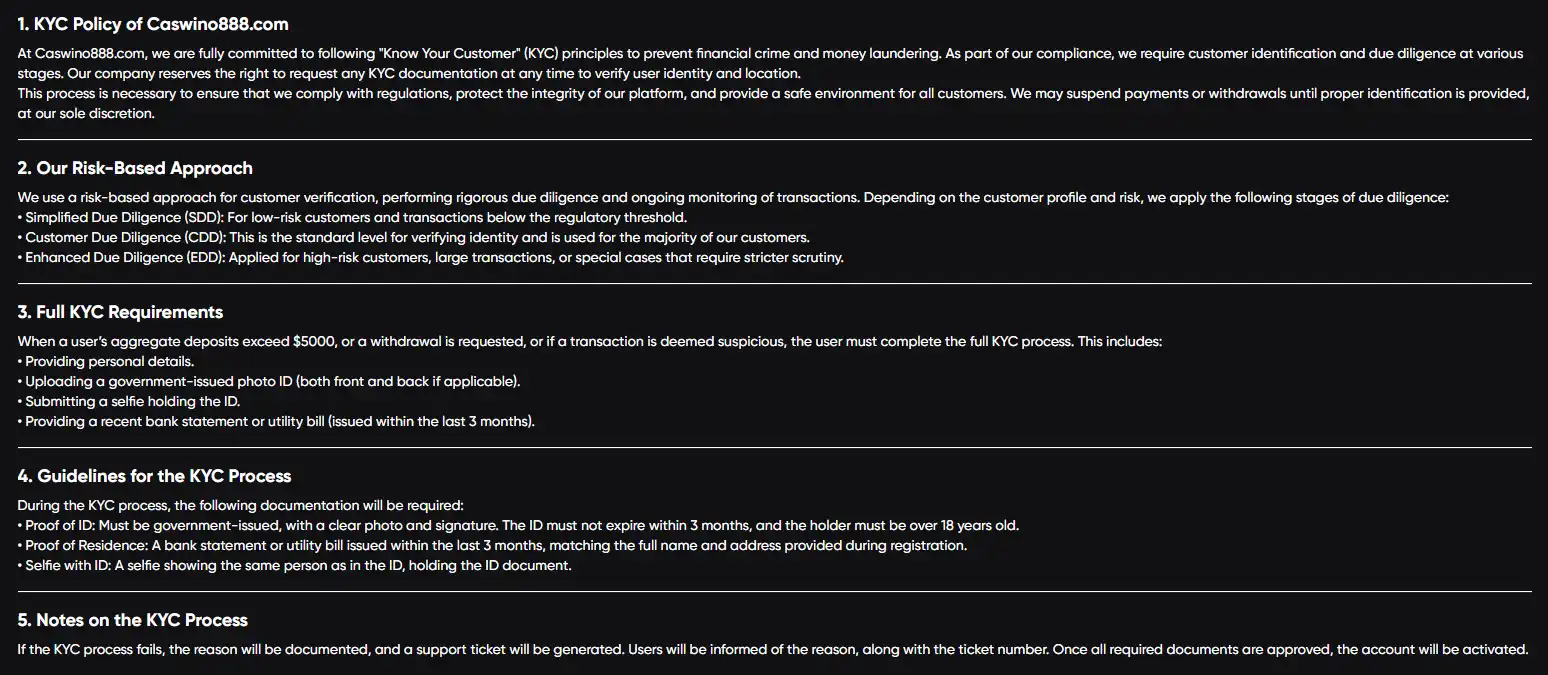
Caswino may require full KYC for withdrawals, aggregate deposits above USD 5,000, or suspicious activity. That makes account verification a possible part of the payout process rather than a separate issue that can always be considered later. The detailed payout guide explains how withdrawal requests, verification and method choice fit together without turning individual review timelines into a general promise.
KYC complaints are about process, not proof of wrongdoing
Verification is one of the areas where review language can become emotionally charged. A player who has supplied documents and is still waiting naturally experiences the process as a delay. The operator may view additional checks as part of its account-security or compliance procedures. Public complaint threads can document that tension, but they rarely provide enough information to determine the full reason for every request.
The strongest reading is therefore practical rather than accusatory. If a withdrawal becomes subject to KYC, the player may need to provide identity and account information before funds are released. Caswino’s own verification rules allow full KYC in several circumstances, including withdrawals. A review describing extra verification should be read as evidence that this can happen in practice, not as a universal sequence or a guaranteed timeframe.
That distinction is especially useful for readers comparing complaints. A complaint about an unresolved document request is different from a complaint about a rejected bonus code, and both are different again from a licensing question. Combining them into a single “safe” or “unsafe” label removes the detail that actually helps a reader make sense of the evidence.
Bonus complaints often turn on communication and eligibility
Promotions generate some of the sharpest review reactions because expectations are set before the player starts using the offer. One February 2026 Trustpilot review complained that a bonus code sent by email had already expired when the player tried to use it. Caswino’s public reply acknowledged that an expired code had been sent because of a technical delay and said an alternative promotion was offered.
This is a useful example of a complaint that can be understood without generalising beyond the incident. The issue was not proof that every Caswino promotion fails; it was a specific mismatch between an emailed code and its active status. It also shows why promotional messages should not be treated as permanent terms. Offer availability, minimum deposits and conditions can change, and a current promotion should be checked against the terms displayed when it is actually claimed.
Reviews are particularly weak evidence for precise wagering conditions. Players may describe a bonus as easy or difficult to clear without stating the exact rules that applied to their account. For that reason, review sentiment is better used to identify communication problems or recurring misunderstandings than to reconstruct exact bonus terms after the fact.
What the Australian reviews add to the picture
A noticeable share of the visible Trustpilot feedback comes from reviewers marked as being in Australia. Their comments cover usability, support, withdrawals, bonus issues and account access. That makes the profile more relevant to Australian readers than a sample made up entirely of users in unrelated markets.
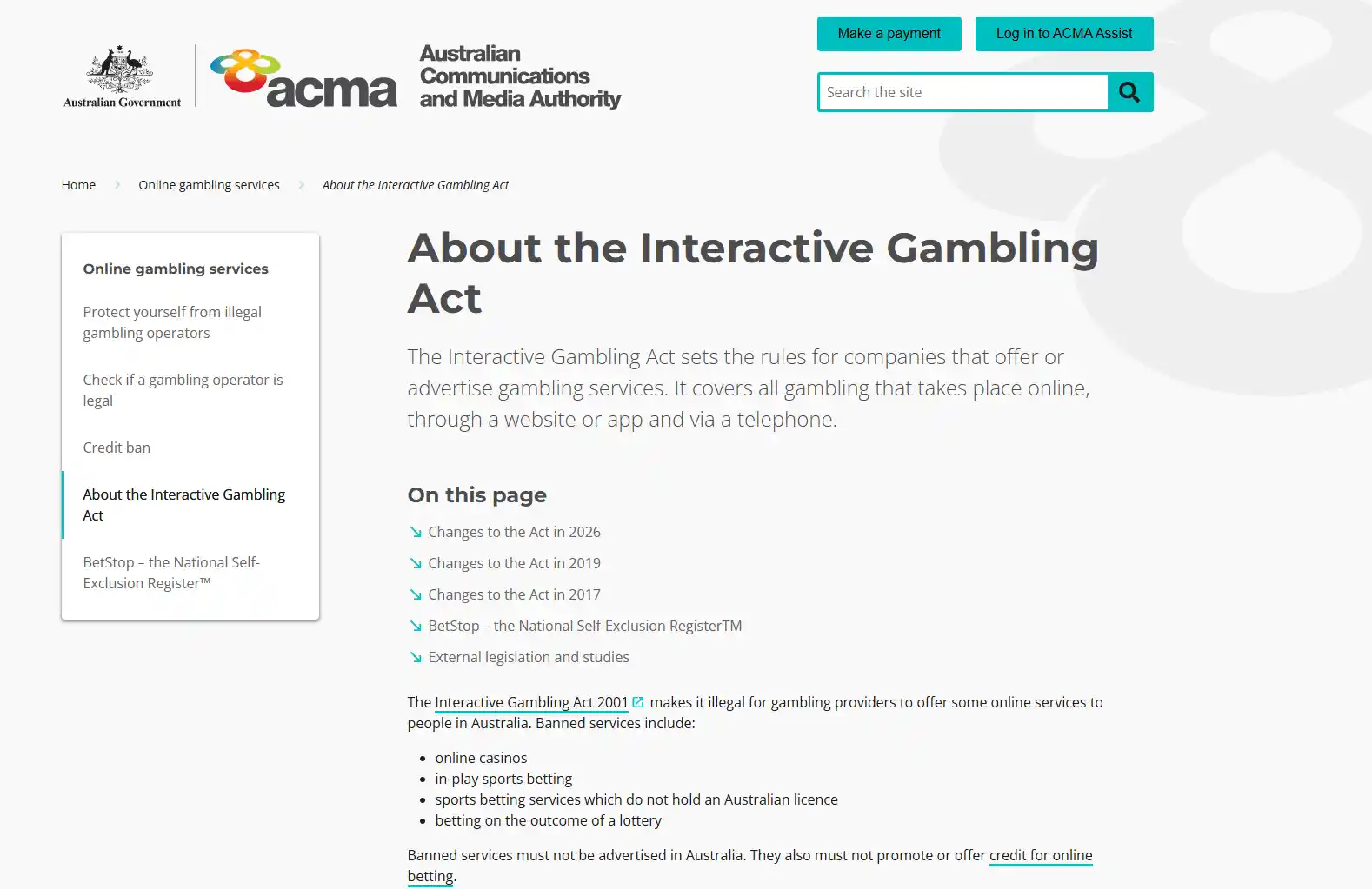
Country labels still need careful interpretation. They indicate the reviewer profile shown by Trustpilot, not that Caswino holds an Australian online-casino licence or that the reviewer received Australian regulatory protection. Caswino’s offshore licence and Australia’s rules for online casino services are separate issues. The Australian legal context explains that distinction in detail.
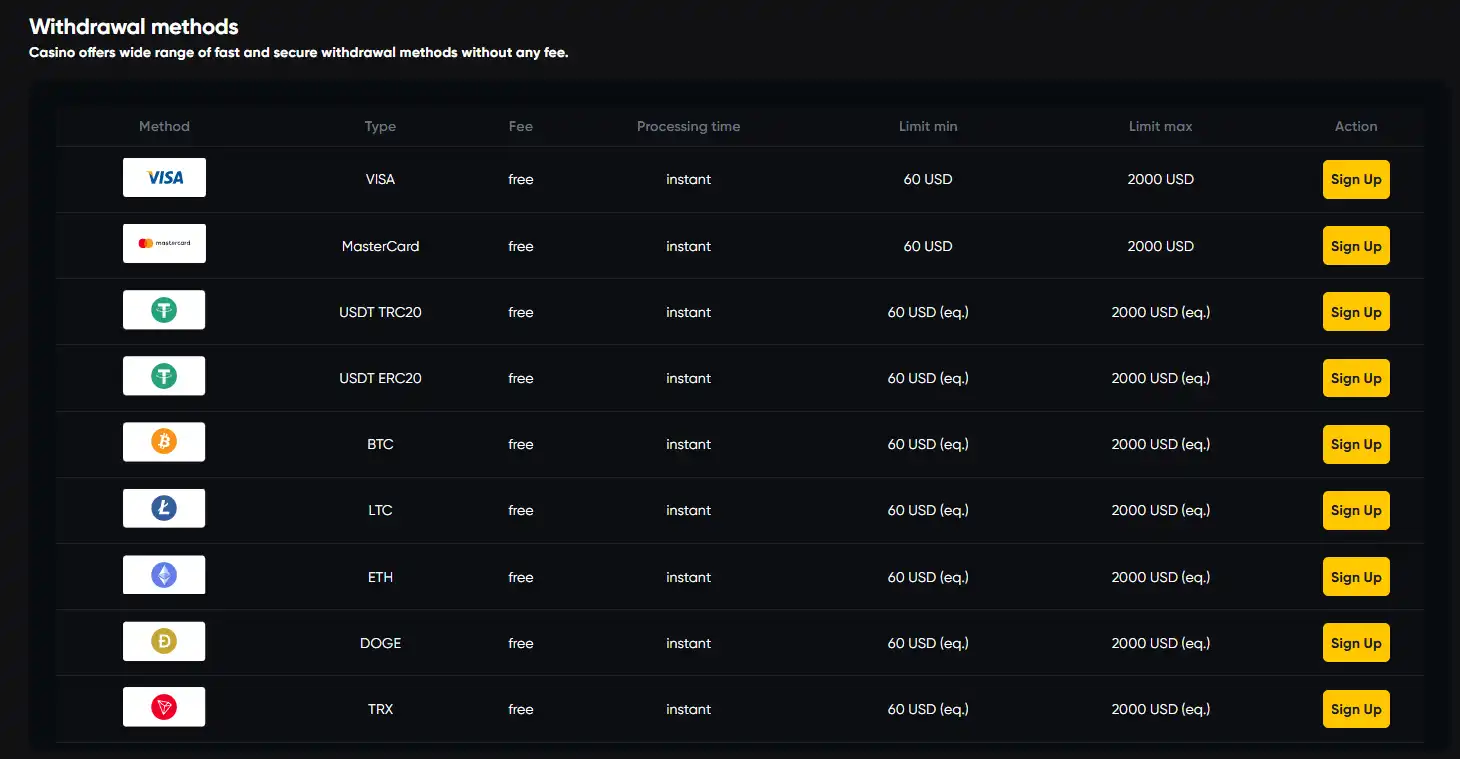
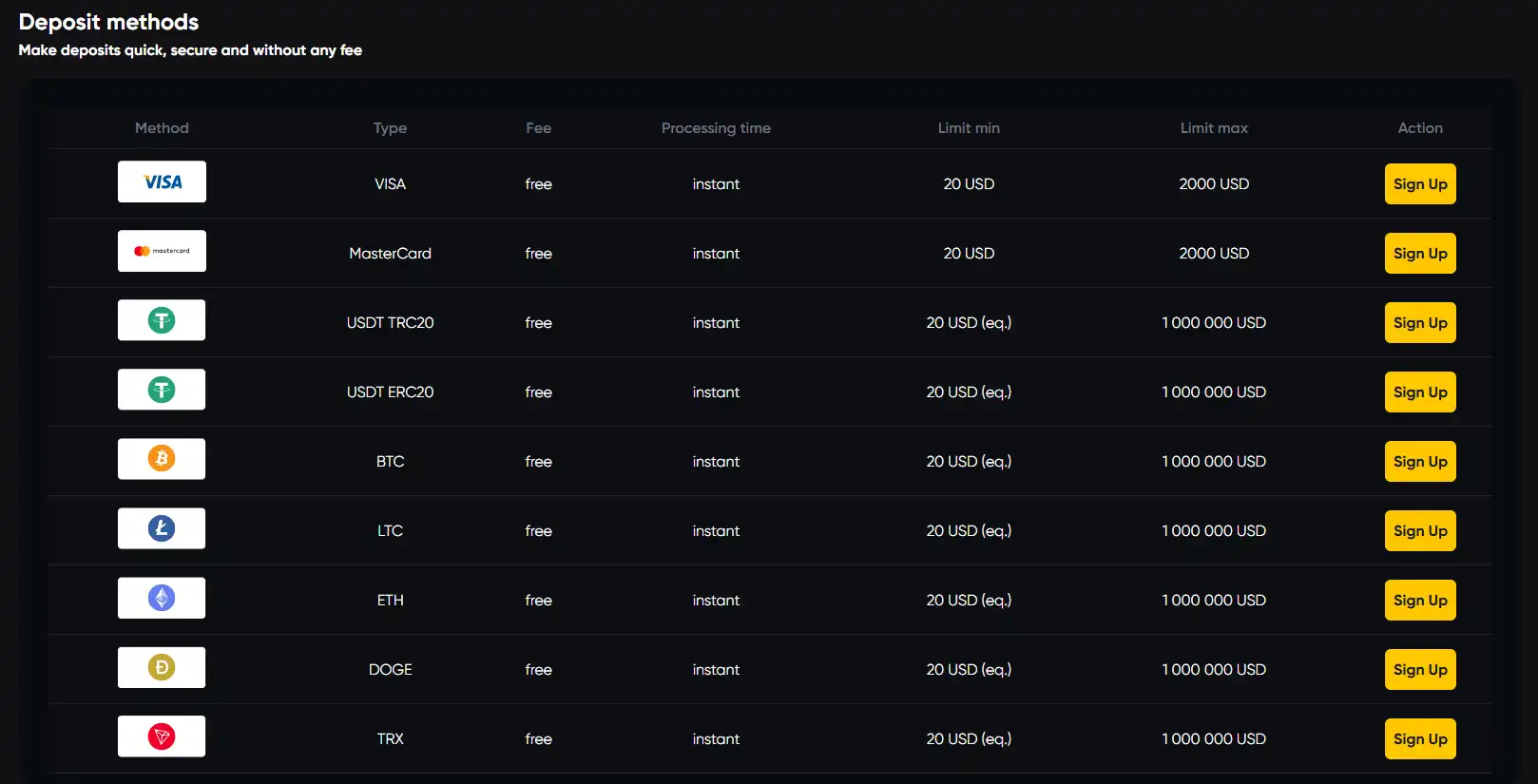
It is also possible for two Australian reviewers to have very different experiences because they use different payment methods, bonuses, devices or account histories. Cryptocurrency support, for example, includes BTC, ETH, USDT, LTC, TRX and DOGE, but a crypto user’s transaction path is not the same as a card user’s. Reviews can highlight these differences, but they rarely provide enough controlled detail to compare them fairly.
Casino Guru adds complaint detail, but its signals also need context
Casino Guru is useful because it publishes complaint case histories rather than only star ratings. Its current Caswino review lists several submitted complaints and also notes that the available user-review sample on its own platform is too small to calculate a user satisfaction score. That is a helpful reminder that reputation metrics depend heavily on sample size.
Complaint outcomes also require interpretation. A rejected or closed complaint does not automatically mean the player had no genuine problem, just as an accepted complaint does not prove that every account is affected. The case history, operator replies and closure reason matter more than the label alone.
Casino Guru currently lists Caswino under a Comoros (Anjouan) licence and presents a separate Safety Index based on its own methodology. That index is a third-party assessment, not an Australian regulator rating. Licence evidence and local regulatory questions remain better handled through the dedicated licence details page rather than inferred from a review site’s score.
How to read a casino review without overvaluing it
A useful player review usually contains specific, checkable context: the approximate date, the part of the service involved, what the player tried to do, what response they received and whether the issue was eventually resolved. A short statement such as “great casino” or “scam” contains far less information, even if the rating itself is strongly positive or negative.
Look for patterns across independent reviews rather than a single dramatic story. At Caswino, interface usability and support praise recur in several positive reviews. Access and bonus communication appear in negative feedback. Withdrawal and KYC concerns become more visible when Trustpilot is read alongside longer complaint cases. These patterns are informative because they identify subjects worth checking before relying on the service.
Also separate what a review can establish from what it cannot. A reviewer can credibly describe their own successful withdrawal, but cannot guarantee yours. They can report a support conversation, but cannot establish company-wide response times. They can describe a bonus-code problem, but cannot define the current terms for every player. This boundary keeps anecdotal evidence useful without turning it into a false factual guarantee.
Signals worth watching as more Caswino feedback appears
Caswino’s public review footprint is still developing, so the most informative changes will come from repeated themes rather than small movements in the aggregate score. More independent reports of successful or delayed withdrawals would make the payout picture clearer. Repeated comments about KYC could show whether complex verification is exceptional or common. New feedback about account access and support would also help distinguish isolated technical problems from persistent service issues.
For now, the evidence is mixed but readable. Recent feedback is mostly positive about navigation and some support interactions, while negative reviews identify concrete problems around access and promotions. Longer complaint records show that withdrawals can intersect with verification in ways that are not visible from a star rating alone.
The best use of Caswino player reviews is therefore as a set of practical warning signs and positive signals, not a substitute for checking the underlying rules. Read reputation alongside licence information, Australian legal context and the actual withdrawal process. That gives each type of evidence the weight it deserves and makes the small current review sample far more useful than a single headline score.
Published by the Caswino Casino team.